Hazards in Collections: Reducing the Risks – Radioactive Material
Nigel Taylor-Jones – April 2026
This is the fourth in a series of blog posts celebrating and sharing the knowledge received from the Hazards in Collections: Reducing the Risks training program offered by the Museum Development South West with thanks to funding from National Lottery Heritage Fund and Art Fund with support from Arts Council England.
Something that might not cross your mind as a concern in museum collections is radioactive material – surely there is none of that! Many things are very low emitting in radiation, as we will go on to discuss, but there are some items which can have harmful levels of radiation.
Radiation levels must be managed in accordance with the Environmental Permitting Regulations and the Ionising Radiation Regulations. These laws are complex and cover a wide range of industries so it can be challenging to figure out how these apply to Museums in practice. Museums in the UK must also consider how to integrate their legal obligations for working with radiation with accepted museum ethical guidelines, SPECTRUM 5.1 and the current Accreditation Standards.
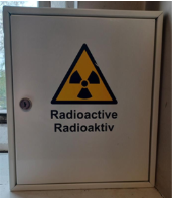
Radiation safe
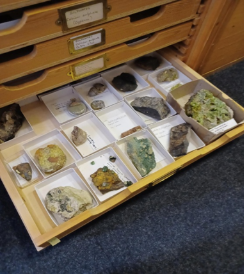
A selection of radioactive torbernite - containing uranyl phosphate and thorium.
Generally, the levels of radiation emitted from Museum objects in our collections are low but that might not always be the case. Critically the level of exposure over time when considering personal safety for staff and others in the museum setting is what matters. Careful planning must be given to the proper storage and handling of such objects and access should be restricted. Regular monitoring of radiation levels, at least once every 12 months, should be undertaken as these can change over time. Fortunately, Gloucester City Council has access to a Geiger counter which measures radiation levels in micro-Sieverts. The emission of the radioactive gas Radon from some mineral specimens is also something that requires careful consideration and risk management strategies.
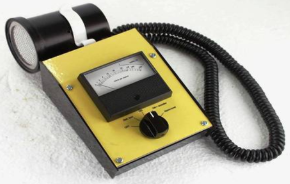
Geiger counter for measuring Radioactivity in Museum objects.
Areas storing radioactive objects should also be clearly signed and included in Emergency & Salvage Plans and any operations which involve interaction with these materials must be properly risk assessed. Educating and training of staff involved is also crucial to avoid any unnecessary and harmful exposure.
Types of radiation
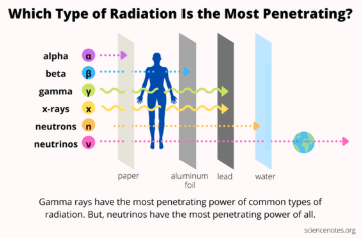
Generally radioactive objects in a museum collection would emit alpha or beta type radiation. Alpha radiation can travel a few centimetres in the air and can be blocked by paper or skin, whereas Beta radiation can travel a few metres, and can be blocked by some plastics, aluminium and wood. Gamma rays which are more damaging have a very long range and can be blocked by concrete or 1.5mm of lead. This is in part why radiation cabinets tend to be lined with lead.
What is safe in a museum context?
It is important to understand exposures in context. Background radiation is present everywhere in nature, and in the UK every person is exposed to 2-4 micro-Sieverts of background radiation annually. In Cornwall— a popular holiday destination-average exposure can be almost 3 times this level due to the complex minerals contained within the igneous bedrock. By comparison, spending one hour per year doing a visual inspection of the Museum collection might give an external whole-body dose of 20 micro-Sieverts, equivalent to spending approximately 1 - 2 days in Cornwall. Comparisons like this are generally reassuring, but do not mean the risk can be ignored. It is generally considered that an exposure level of 10 micro-Sieverts or less per year shows no observable health effects and can therefore be considered ‘safe’.
Where do you find radioactive materials in the museum?
Some objects within the collections of the Museum of Gloucester, including geological mineral specimens, luminous paints and certain glassware can contain elements like uranium, radium, tritium and potassium 40, which can emit harmful radiation. We also have items such as gas mantles, which contain Thorium Dioxide and are slightly radioactive.
Luckily for us, one way of discovering whether an item such as dials on clocks and radioactive glass are radioactive is they emit a glowing light. Radium or tritium paint was used between the 1930s and 1970s, largely, and can be found in aeroplane dials, clocks, and self-illuminating exit signs! You may have heard of Radium Girls, who would paint the dials on clocks, compasses etc and lick the end of the paintbrush – hard to imagine now!
Thorium was used in a variety of items, mainly due to its strength and ability to be combined with other metals such as magnesium, aluminium and titanium. You can find these in surprising items such as cosmetics, there was a brand called Tho-Radia which utilised them in their make-up. It can also be found in early 20th century toothpaste, which I am sure gave your teeth quite the glow!
Uranium is another radioactive element to some objects which you might find in a museum, such as glass, which is often yellow or green tinged, Geissler decorative tubes (pre-neon lights!), and ceramic glazes. There is this very red ceramic ware which is known as ‘Fiesta ware’ which was very popular in the US.
What is our action plan for dealing with radiation risk at the Museum of Gloucester?
Identify all objects within the collections which have the potential to be radioactive
Produce considered Risk Assessments for all processes involving interaction with or proximity to radioactive substances.
Appoint a Radiation Protection Adviser (RPA) to identify the amount and type of radioactivity (Health & Safety Officer for Gloucester City Council)
Appoint an internal Radiation Protection Supervisor (normally the Museum Collections Officer)
Consult with the HSE on any proposed works.
Move all radioactive material to safe areas, restrict access or use containment with appropriate signage.
Monitor radiation levels on a regular basis.
The Hazards in Collections: Reducing the Risks training program was offered by the Museum Development South West with thanks to funding from National Lottery Heritage Fund and Art Fund with support from Arts Council England.