Hazards in Collections: Reducing the Risks – Heavy Metal(s)
I know what you’re thinking, but when we talk about heavy metal in the collections we are not thinking of a music band, but in fact heavy metals such as lead, arsenic and mercury.
This is the third in a series of blog posts celebrating and sharing the knowledge received from the Hazards in Collections: Reducing the Risks training program offered by the Museum Development South West with thanks to funding from National Lottery Heritage Fund and Art Fund with support from Arts Council England.
As part of the Hazards in Collections: Reducing the Risks program we learnt more about the key players: lead, arsenic and mercury, all of which feature in our collection.
Lead
This dense, soft, dull grey metal and has a white corrosion product. Lead was used in a variety of items spanning hundreds of years and may be familiar to you from the stories of Elizabeth I, who famously used white paint which contained lead, in her face powder, or pencils, and more eery considering the health risks, children’s lead toys!
Lead: Why is it so dangerous?
Lead exposure can damage the brain, nervous system, cardiovascular system, kidneys and reproductive organs. Exposure limits are lower in babies, young children and women.
The main risk with lead in museums is loose pieces, the corrosion product or friable lead paint.
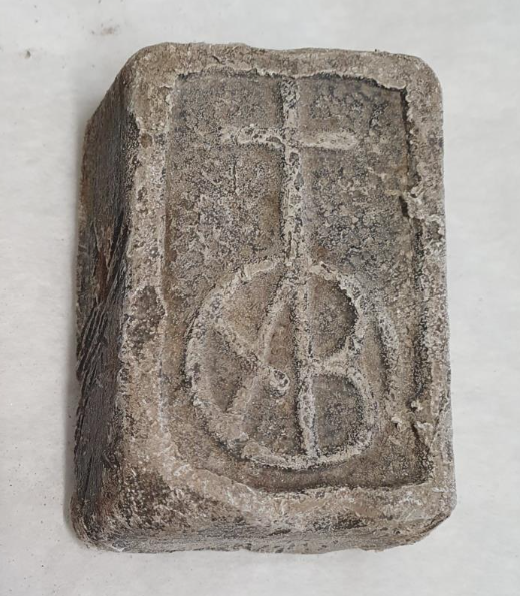
Above: a lead weight.
Lead: where is it in collections?
In the historic collections within a museum lead can be found in ancient items such as plumbing, weights, coffins, amongst other items. It was also used in the Medieval and Renaissance periods for window cames, bullets, cosmetics and the printing press. Lead is also present in pewter items which can range from a plate, teapot, plaque and beyond. Lead was used in garden statues, in lead shot, weights and machinery – even in costume to weigh down certain parts of the garment!
A sneaky way lead has emerged in the collection is also through lead paint, this was common in the 1930s-50s in children’s toys, but was also used in domestic paints, as well as artists work.
At the Museum of Gloucester we have a large collection of lead toys, some lead weights and also minerals with lead in them, such as Galena.
As with many things in the museum environment, lead deteriorates in poor environmental conditions, such as high relative humidity and varying temperatures, and exposure to other agents of deterioration. Some warning signs in paint include a cracked, ‘alligator’ effect.
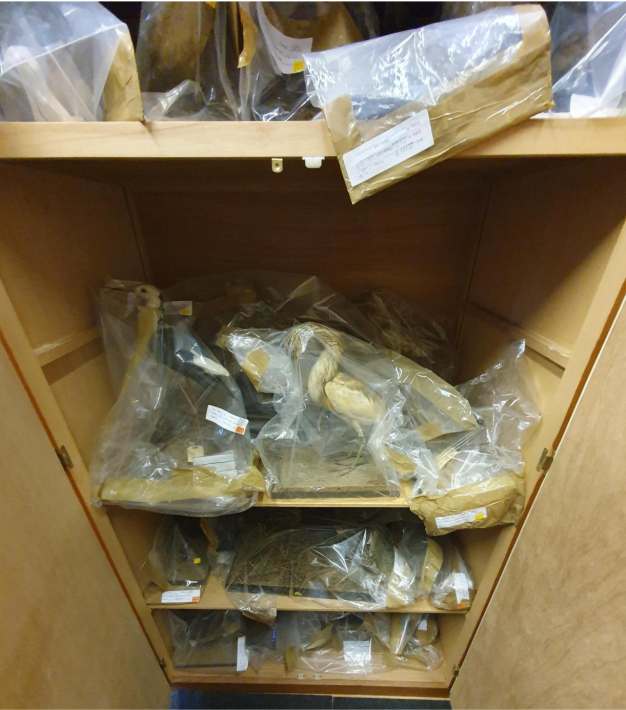
Above: some of our taxidermy collection in bags after pesticide treatment.
Arsenic
Visions of Victorian England spring to mind when you think of arsenic, for good reason, as a huge period of production/use of the product was during this time period. This period of time has even become known as ‘The Arsenic Golden Age’, with items such as medicine, food supplements, poison, dyes and taxidermy containing the hazardous substance.
So, why is arsenic hazardous?
Arsenic is considered toxic, even in small doses, affecting the skin, lungs, bladder, liver, kidneys, and heart. Arsenic is also considered a Class A carcinogen. There is also Arsine gas; Large areas of arsenic material combined with damp/mould (e.g. arsenical wallpaper in a historic house) can produce dangerous quantities of toxic and flammable arsine gas. Arsine is colourless and has a garlic or fish-like smell. The Yellow Wallpaper by Charlotte Perkins Gilman has a slightly(!) different meaning when considered that arsenic was widely used for the bright yellow or bright green pigment in items such as wallpaper.
Where can it be found in the collection?
Arsenic was used as a pigment, even in ancient times, such as Orpiment (yellow) and Realgar (red), as well as in poison and medicine, something which continued well into the 19th century. Arsenic had the incredible ability to be considered both medicine and poison throughout history. However, as stated above, the Golden Age of Arsenic was the 19th century, with poisons, medicines, paints, textiles, book coverings and taxidermy.
In our collection here at the Museum of Gloucester, we have several bright green pigmented items which are believed to contain arsenic. This green was known under the names Scheele’s, Schweinfurt and/or Paris green, and was a colour which exploded with popularity in the Victorian era, being used in textiles, wallpapers and book coverings. We also have a large amount of taxidermy in the collection, which as part of its treatment and processing to taxidermy has had arsenic play a part in its preservation.
Mercury
Mercury is a silvery metal, which is liquid at room temperature and has a number of properties which lend itself to its use in all sorts of items. These properties include conductivity, high thermal expansion, formation of mobile spherical beads when spilled. But there is a darker side to mercury, as can be seen in the depictions of the Mulliner, ‘the mad hatter’ in Alice’s Adventures in Wonderland (aka Alice in Wonderland).
So, why is Mercury hazardous?
Mercury is hazardous because it is a neurotoxin, impacting the brain and central nervous system, as well as affecting lungs, kidneys and the heart. The risks around mercury are not only from the liquid room temperature form but also from an odourless toxic vapour which can build up in the air.
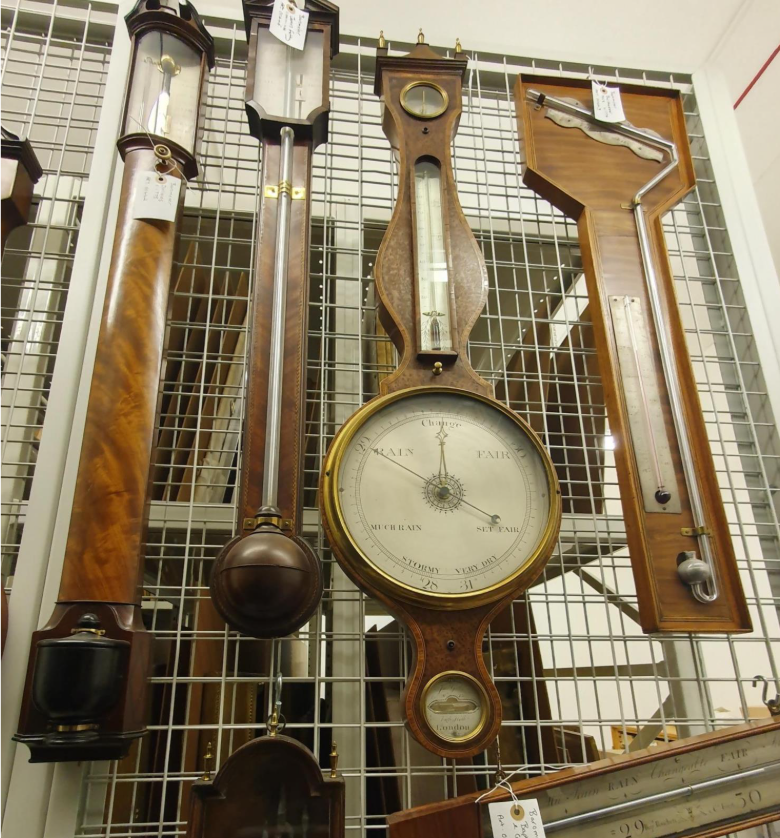
Above: An image of various instruments that have mercury inside them hanging on a wire rack in our store.
Where can it be found in the collection?
Mercury can be found in a number of items, ranging from cinnibar lacquer and pigment, which is a deep red colour, dental amalgam, tin-mercury amalgam mirrors, thermometers, barometers, hats, fluorescent lamps and neon signs. It is also heavily present as a preservative, particularly in items dated from the 18th and 19th centuries. For instance, mercury is used as a preservative in herbariums and taxidermy, which the Museum of Gloucester has a large quantity of.
We have to consider if the item in the collection may contain mercury, judging from the date and the type of object that it is. For instance, if it is a scientific instrument, would it need mercury in order for it to work, such as a thermometer? Not all mirrors contain mercury; the period of time which we would expect there to be mercury present ranges from the 15th century to the mid 19th century, however it was becoming less common after the end of the 18th century. Tell-tale signs of a tin-mercury amalgam mirror are thicker glass, sparkle effect with light shining on it, it can be quite grainy and there may be a silvery liquid in pools or small spherical balls at the base of the frame.
The Hazards in Collections: Reducing the Risks training program was offered by the Museum Development South West with thanks to funding from National Lottery Heritage Fund and Art Fund with support from Arts Council England.