Hazards in Collections: Reducing the Risks – Great Grant! The Natural History Store is NOT a Bore!
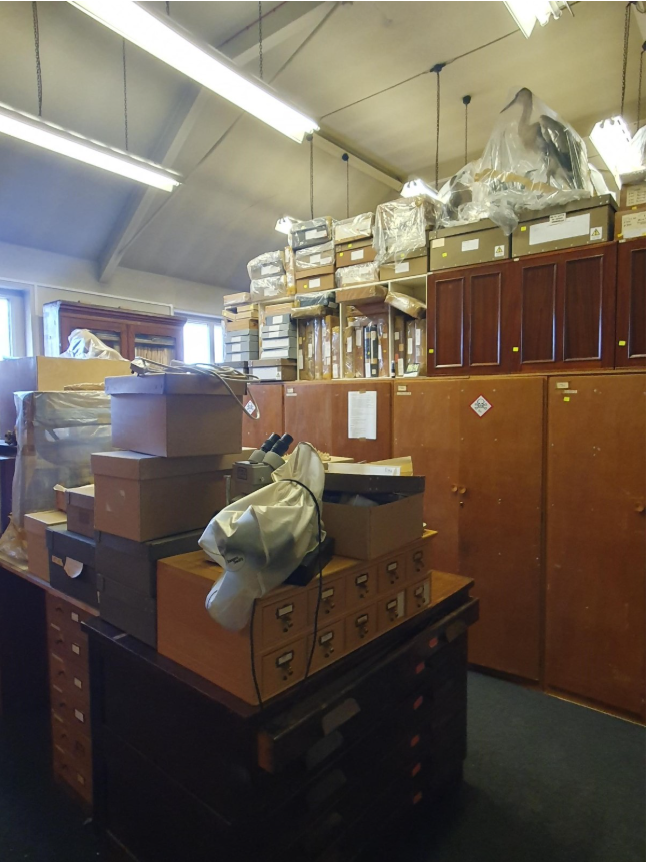
Above: an image of part of our Natural History Store.
This is the fifth and final post in a series of blog posts celebrating and sharing the knowledge received from the Hazards in Collections: Reducing the Risks training program offered by the Museum Development South West with thanks to funding from National Lottery Heritage Fund and Art Fund with support from Arts Council England.
After the training, which was delivered by MDSW on Hazards in Collections, we were better informed about numerous hazards, and it highlighted areas which needed attention. One aspect of our collection which we are less confident on in terms of hazards was our Natural History Store. In the 1990s the Museum of Gloucester lost their dedicated Natural History Specialist, who at the time took care of our 66,000 strong Natural History collection, which includes taxidermy, herbariums, entomological specimens, fossils and minerals.
We applied for funding from MDSW to write a report on the hazards in the Natural History Store, how to mitigate the risks involved and how to approach a collections move of this store. We were very fortunate to be successful in this application, and we had a conservator from Bristol Museums, Fran Coles, come and assess our Natural History Store.
What did we find out?
We have several hazards in our Natural History Store, and we have identified some objects which may contain hazards and what to look out for in our collection. A large proportion of our Natural History collection is not recorded electronically, and the records are not easily accessible, therefore having a list of items which we know are hazardous and what to look out for was very helpful. This was particularly helpful in relation to minerals. We found that there were many minerals which are hazardous but that we were unaware of.
We knew we had hazards in terms of the taxidermy, with potential mercury and arsenic used as preservatives in a lot of taxidermy during the 18th and 19th centuries. We currently have packed all the items in a self-contained manner so that we can safely handle them and we also have handling procedures. We have received advice on creating an individual risk assessment for the task of handling and/or cleaning the taxidermy.
Further to this, we have a very large collection of Herbariums in wooden cabinets with wooden drawers; inside these drawers they have tissue wrapped round them. Currently we have an extractor fan in case of any mercuric vapours, because herbariums have mercuric chloride in them as a preservative. However, we have been advised to ventilate this space before handling, as well as given additional advice on correct PPE and risk assessments.
Finally, we have our minerals; the minerals in the collection are not extensively recorded, and although the collections team have some knowledge, due to capacity and resources a lot of the mineral collection is less documented than it could be. We do not necessarily, therefore, know what hazards lurk within. One of the most important things we learnt from the hazards training and the conservation report from Fran, was what minerals are harmful and what minerals have potential to be harmful. It highlighted further work we need to do with the mineral collection, including a hazards assessment prior to any collection's movement.
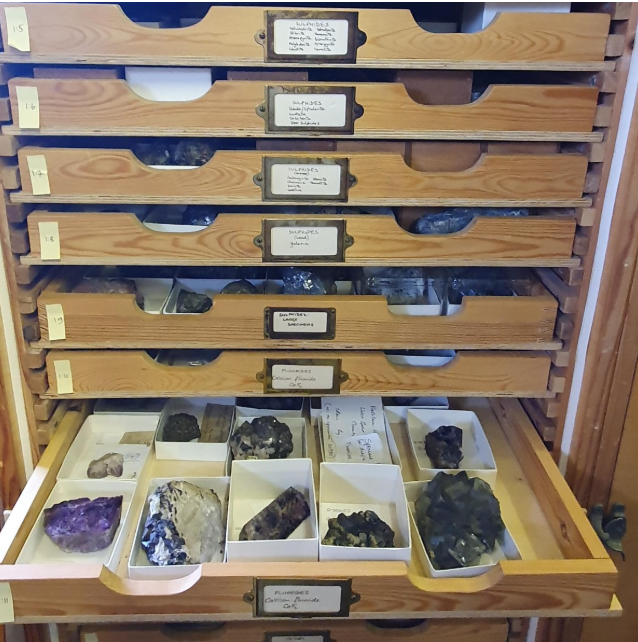
Above: Some minerals in one of our many mineral cabinets.
Here are a few radioactive minerals which we learned to look out for:
Minerals with high levels of Uranium in:
Carnotite
Torbernite
Metatorbernite
Autunite
Uraninite (Pitchblende)
Minerals with high levels of Thorium in:
Monazite
Pyrochlore
Thorianite
Thorite
What should we do?
Have a series of individual risk assessments for hazards such as handling minerals, herbariums and taxidermy.
Have a logbook for the risk assessment, so it is known who has read it.
Have a hazards checklist, and a way of monitoring if an item has been logged as hazardous or in fact found to be non-hazardous.
Continue to work on and add to our hazards register.
Ventilate our Herbarium cabinets for at least half an hour before working with them.
Wear appropriate PPE when handling hazardous items, and items which may contain a hazard.
Create a heat map of where radioactive materials are.
Distribute the radioactive material evenly in the cabinet.
An audit of the mineral collection for any hazardous materials.
Be proactive with labelling: as soon as an item has been confirmed as having a hazard, we should be labelling this and adding it to our register.
Ensure the hazards are recorded on our collections management system.
If you have been following the blog series, you will also know that we have a Geiger counter and that we will also be testing the levels of radiation periodically.
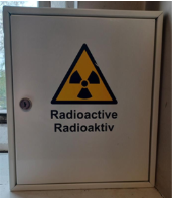
Above: an image of our radiation cabinet.
Lessons learned:
We realised through the training and the report that we did have some measures in place, but they were not necessarily easily practicable, and many could be developed and improved to further reduce risk. For instance, we have a hazard register, but we did not have an easy way of searching this to see if an item was hazardous. Now we will adapt our current register so that it is easily searchable by location, as this was decided to be the most helpful for our team.
We also did not consider a hazards checklist which would help in defining if anything has any potential hazards. Currently we do not have a system whereby something is non-hazardous and recorded as such; we record if something has a hazard but not whether it has been checked and found to be harmless. This was something which had not necessarily been immediately apparent as a step in our hazards assessments and will now inform our processes for the future.
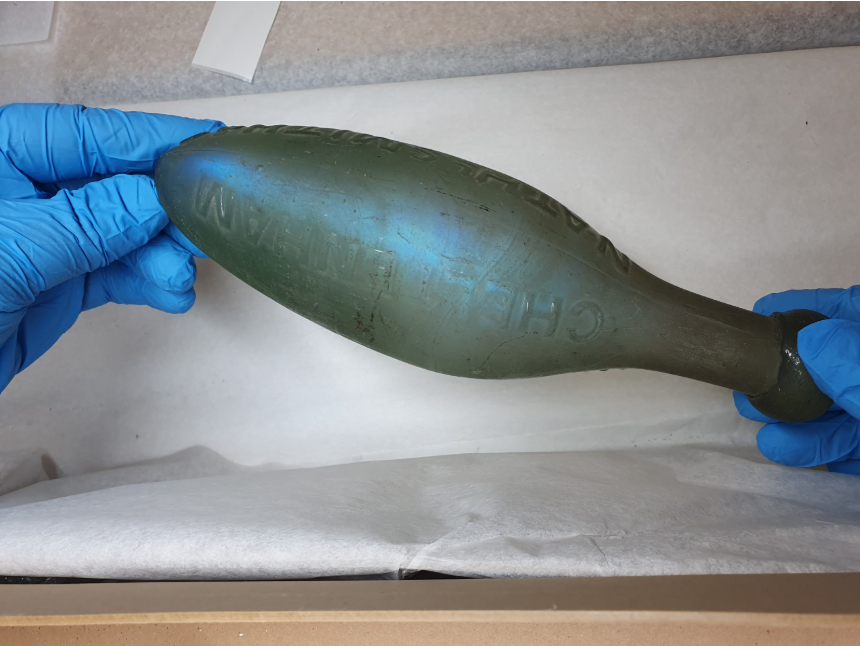
Above: an iridescent sheen on a bottle in our collection, determined to be non-hazardous.
We have learnt the value of a simple checklist to record hazards and to gauge whether something may possibly have a hazard – for instance with asbestos, having a spreadsheet with the qualities that it was used for: thermal insulation, sound insulation, fire prevention or cement based products used in them. All these items can help flag if they have a possibility of containing asbestos. Something like this can be implemented for other hazards, such as mercury containing items.
The Hazards in Collections: Reducing the Risks training program has been incredibly helpful in enlightening us by helpfully associating time periods and objects with certain hazards. Enabling us to develop an understanding of what types of items may contain hazards and pre-empting potential hazards before we approach an object.
We also discovered more about identifiable features of hazards and how to mitigate the risks of these hazards. Without the training we would be more in the dark about the dangers which lurk within our collections, and we would not have had the opportunity to apply for the grant to look into our Natural History Store hazards.
We now have a really good understanding of potential hazards, where to find them and how to mitigate them as well as the best way to record them so that it works for our team. An invaluable lesson has been that we could and should adapt practices to make it easier for our use.
This grant was awarded by Museum Development South West with thanks to funding from National Lottery Heritage Fund and Art Fund with support from Arts Council England. A huge thank you to them for providing over 60 museums with advice, guidance and training on hazards in collections and for providing several grants to museums like ours to mitigate the hazards in the collection.