Hazards in Collections: Reducing the Risks - The Big ‘A’
This is the second in a series of blog posts celebrating and sharing the knowledge received from the Hazards in Collections: Reducing the Risks training program offered by the Museum Development South West with thanks to funding from National Lottery Heritage Fund and Art Fund with support from Arts Council England.
In this blog post we will be discussing asbestos in historic collections.
Asbestos, what is it and why is it hazardous?
Asbestos is a hazardous fibrous material which is naturally occurring in different mineral forms and historically has had a wide variety of uses in industry and manufacturing.
Exposure to asbestos fibres through inhalation can prove fatal but symptoms of respiratory diseases can take between 15 – 60 years to appear. It is conservatively estimated that, to date, 10 million people have died so far from exposure to asbestos, and a further 10 million will die over the next 20 years.
By law (CAR regulations) the Museum must have an asbestos register for the building detailing the location of asbestos. Known objects within the collections which have asbestos in them must also be recorded and reported so that with specialist advice they can be made safe or sometimes removed if appropriate.
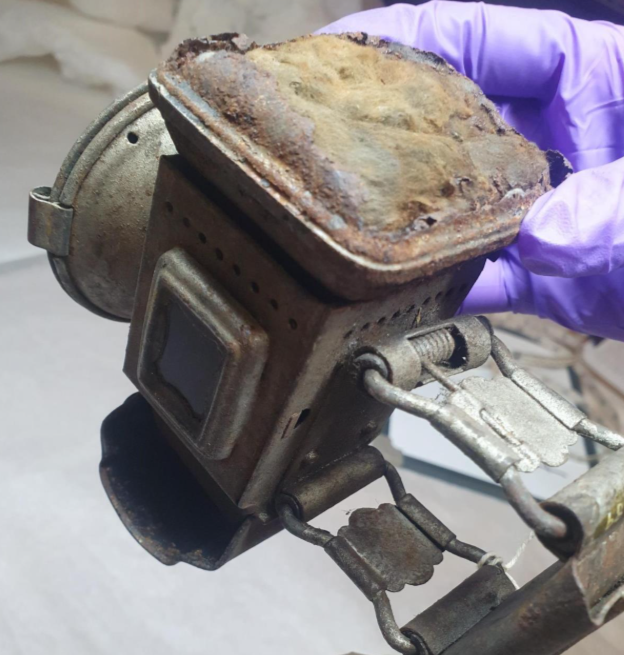
Above is an image of a corroded base of a bicycle lamp with asbestos exposed.
There are different types of asbestos:
Asbestos is an item which quite often is drawn to our attention when we buy homes with artex ceilings or insulated lofts. Therefore, it may or may not be news that there are different types of asbestos.
The first is Chrysotile, commonly known as ‘white asbestos’. Fun fact: Chrysotile was used for the snow in the Wizard of Oz films and was banned in the UK from 1999 (the asbestos, not Wizard of Oz).
Another type of asbestos is Amosite asbestos, commonly known as ‘brown asbestos’, which was banned in the UK alongside ‘blue asbestos’ in 1985.
This brings us to the third most common type of asbestos, Crocidolite, commonly known as ‘blue asbestos’.
There are a further three types of well-known asbestos: Anthophyllite, Actinolite and Tremolite, which were all banned in the UK in 1992.
So, where might we find asbestos in our collections?
As a naturally occurring mineral, it can be found in geological collections under the names Amosite, Chrysotile, Crocidolite, Anthophyllite, Actinolite and Tremolite. However, we also discovered from our training that in some minerals there may be contamination from asbestos minerals, even though the main mineral in the compound is a different, completely harmless one. For example talc and soapstone may contain asbestos minerals as a contaminant. In the Museum of Gloucester’s collection we do have several asbestos mineral specimens.
Asbestos was also widely used in the early to mid-late 20th century, due to its fire retardant properties and tensile strength. It was often used as a thermal, acoustic and electrical insulator meaning it is likely found in wires, 20th century electric heaters, irons and other domestic items. We have a number of 20th century items, such as early electrical toasters, asbestos wicks in lighters and irons, and many electric heaters. In addition to these more obvious items, we also have to consider items that are Bakelite, as asbestos was an ingredient in this popular, early to mid 20th century plastic.
Here at the museum, we recently had to have an asbestos specialist remove a lantern with exposed corroded feet which contained asbestos.
Asbestos as a material is flexible, resistant to chemical corrosion and condensation and abundant in supply. This abundance made the item cheap and easy to purchase which is why it’s commonly found in the 20th century objects, and why we find it across both our social history domestic items and in gas masks from the Second World War (we’ve even found it in a Second World War badge).
We are also aware that asbestos can be in cars, within the brake pads, clutches, and engine parts to name a few, as well as radios where electrical components are present. Lagging is quite often asbestos, and cord around stove and kiln doors can also be asbestos.
While training we also learned about another surprising place we might find asbestos was in the archaeological and ceramics collections. Apparently there was a period in time, around the 1970s where conservators would infill ceramic fractures/broken pieces with an asbestos mixed filler! It goes to show that even if we know items which we are very conscious of having asbestos in, there may be a very bizarre outlier.
Within the collections there seems an endless amount of items which may have asbestos in them. However, the level of risk associated with asbestos varies; most of the time, if undisturbed or imbedded in the fabric of an item its risk may be lowered.
Here at the museum we have to mitigate these risks with risk assessments, hazards registers and by understanding how and when to handle items. For example, we have an awful lot of items containing Bakelite, but as long as we understand there is a risk here, follow procedures and check the condition, ensuring it is not broken or producing dust, we should be able to mitigate the risks.
Of course, there are some items which we are unable to justify the risks involved, such as exposed asbestos in wires or unsealed asbestos in items which pose too great risk compared to their curatorial value. These are being assessed by our collections team and potentially disposed of (please see our previous blog on hazardous disposals).
We do not dispose of items that are significant and we follow the Museum Association and Heritage Sector’s ethical standards and guidelines.
The Hazards in Collections: Reducing the Risks training program was offered by the Museum Development South West with thanks to funding from National Lottery Heritage Fund and Art Fund with support from Arts Council England.