
Discovery Centre Finds - Stoneware Jug
CR1852 From Store to Store
Archive Blog post no. 7
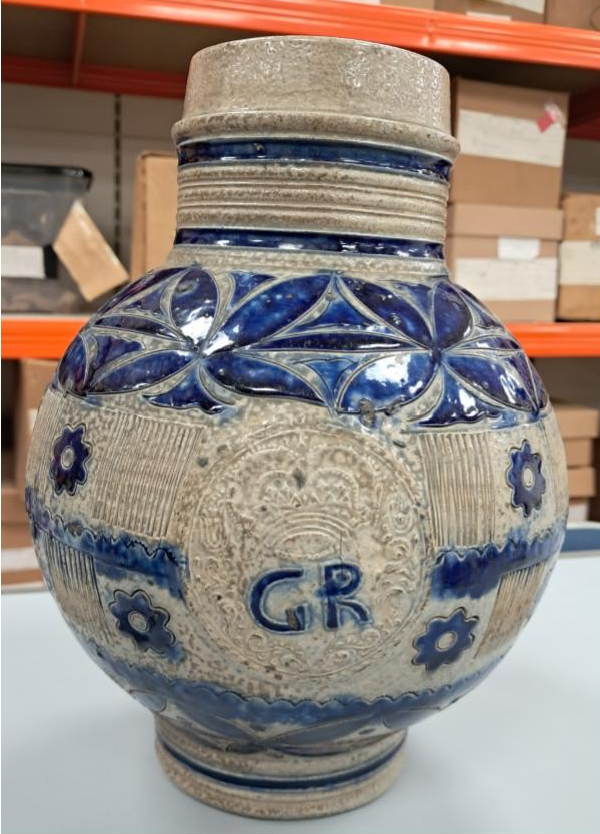
Stoneware jug (findspot unknown)
This large stoneware jug is recorded as coming from a garden in Gloucester. Its near completeness suggests that may have been found in an old well or cess pit. The jug is of a type of pottery known as Westerwald stoneware, which was made at Westerwald in the Rhineland-Pfalz area of Germany in the 17th and 18th centuries. Stonewares were fired at very high temperatures in excess of 1100 °C to produce very hard and durable pots. The pots from Westerwald were salt-glazed and painted with contrasting cobalt blue or manganese purple designs. A salt glaze, where common salt is thrown in the kiln during firing, produces a shiny, dimpled texture.
Westerwald stonewares were highly decorative and widely traded from the 1690s up to the 1760s or a little later. Those reaching the British Isles were traded up the Rhine to the Low Countries and distributed via Dutch merchants. Many pots, including this example, were specifically made for the British market. This one carries the initials of the monarch ‘GR’ set within a stamped medallion showing a crown. The jugs are difficult to date precisely but the blue-banded neck appears to be an early trait, which suggests that this GR in this instance was George I (1714–1727). Large jugs such as this were used for serving drinks and some are marked to show the capacity. Others were equipped with hinged pewter lids that were attached to the handle (missing here).
