Discovery Centre Finds - Post-medieval glass bottle with seal
CR1852 From Store to Store
Archive Blog post no. 6
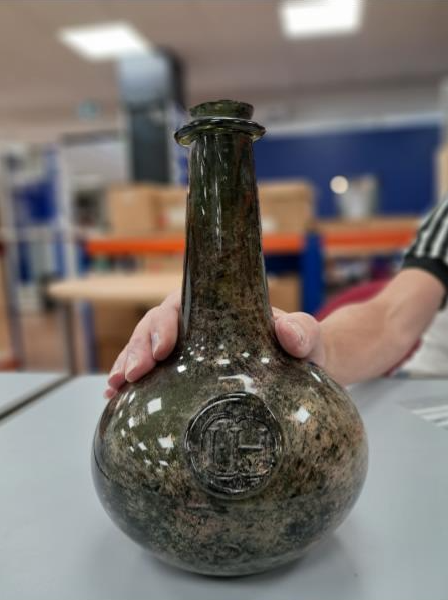
Post-medieval glass bottle with seal (findspot unknown)
Bottles of dark green glass for use as containers for wine or spirits were produced in England from c. 1650 onwards. The earliest bottles are those with globular bodies and long necks, such as this ‘shaft and globe’ type. The shape increased stability and assisted with storage and transit, allowing the bottles to be stacked ‘top to toe’ in layers. Their capacity is usually a quart, equivalent to a quarter of a gallon or around two pints. England became a major manufacturer of glass bottles, with Bristol among the main centres of production. The bottles were made by the free-blown method using a blowpipe, and a trailed ‘string’ rim was then added to assist in sealing. Their robustness enabled the bottles to be transported safely and many thousands were shipped to the continent and America in the later 17th and 18th centuries.
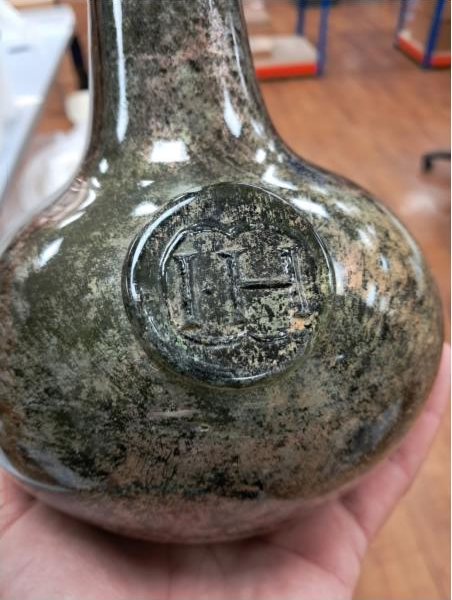
The practice of affixing glass seals, such as that seen on this example, began in the 1650s. The seal may have identified the person commissioning the manufacture of the bottles rather than the manufacturer themselves. This might have been a private individual or family, or perhaps the name of a hotel or an inn. The identity of the ‘I.H’ named in this example is not known. Up until the end of the 17th century, the letter I was used in place of the modern J, so it here may indicate John or similar.