
Delightful Disposals: Arguably the world’s largest can opener collection (not really!) finds new home
The word disposals in Museums sparks complete terror, surrounded by misapprehension and concerns over misinformation. The Museum of Gloucester has over 750,000 collection objects, of this number there are around 25,000 social history items. We are currently in the process of reviewing and rationalising our social history collection whilst we move them to a new storage space.
What does this mean?
This means that we are looking into the curatorial relevance of the collections, whether it matches our Collections Development Policy, is in a good condition, or highlights and celebrates Gloucester’s history – to name but a few of the criteria we are looking into. Following Museum Association guidance on disposals we are making tough decisions on whether our collection items are relevant. This does not mean we are going to put items in the bin and it certainly does not mean a sad life for these objects. We are essentially wanting to rehome irrelevant collection items so they can be used, displayed and researched.
Our current situation:
Through years of poor collecting habits and poor storage we have a mass of items which are not relevant to Gloucester, are in a poor condition or are even hazardous. You may think ‘what gives you the right to dispose of items I might want in the museum?’; this is a fair question, and when we decide these things we decide with several staff members and volunteers, before escalating the decision higher up. When we do this with items such as glass pig ornaments, biscuit tins, candle holders etc. we have researched these items thoroughly to decide the outcome and we never dispose of anything that we are unsure of.
Delightful disposal
It really is a wonderful thing, we have found a new home for around 100 objects, including 87 can openers, and c.13 knives and forks that were made in Sheffield or have links to Sheffield. These items have found a new home at the Ken Hawley Collection Trust at Kelham Island Museum in Sheffield. These can openers were donated by one enthusiastic Gloucestershire collector, many of them having been made in Sheffield or further afield, but none connected with Gloucester or even Gloucestershire. By donating to the KHCT we have given these objects a new lease on life and made them relevant to something; within the context of a tool collection these items are prized and interesting.
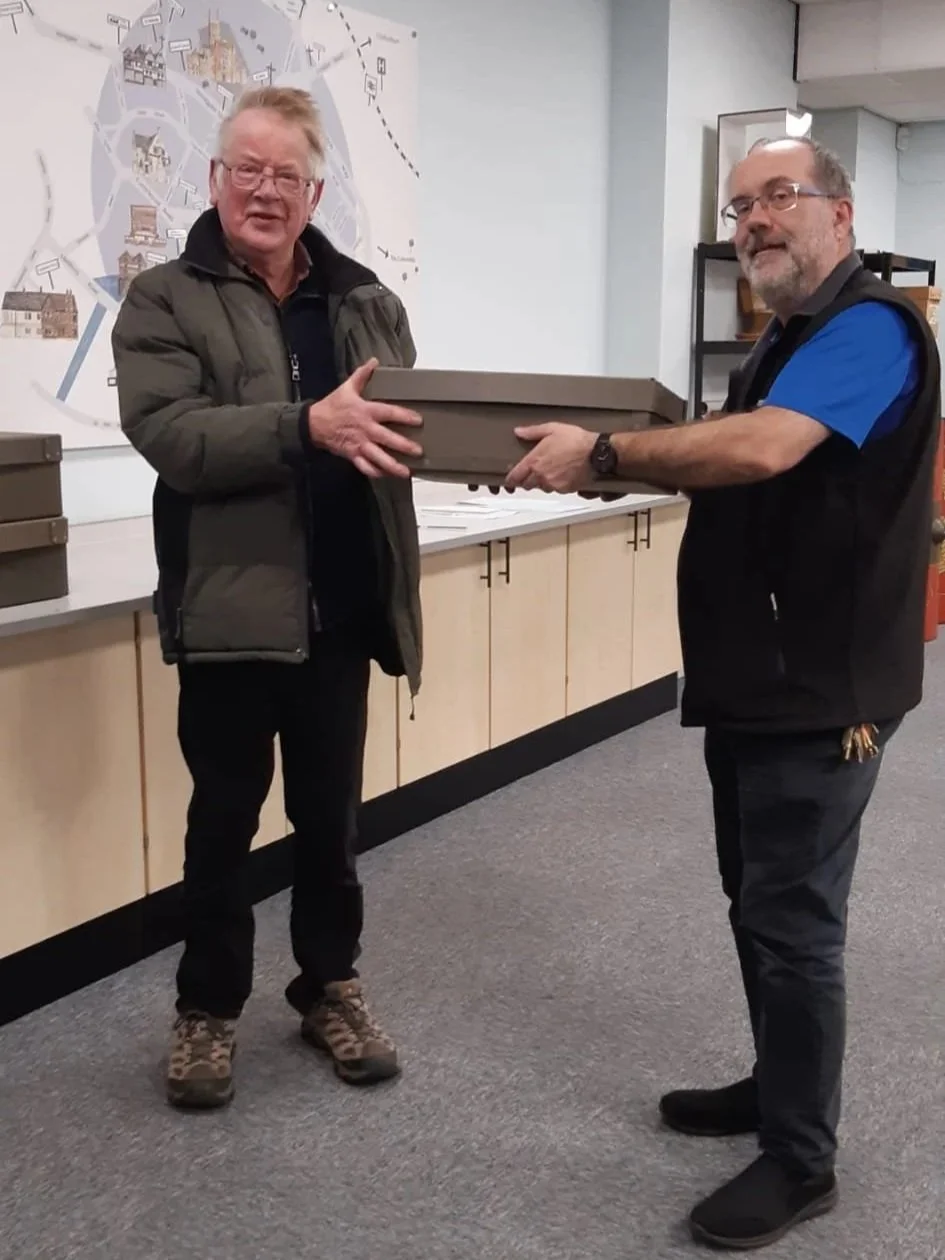
Above: Nigel (Museum of Gloucester, Collections Team Leader - right) handing over the can openers to Geoff (KHCT volunteer - left)
Let’s hear about their new home from Geoff Pearce, the volunteer who led on the collections transfer:
The Ken Hawley Collection Trust was formed in 1994 as the making of tools, cutlery and silverware in Sheffield declined and as such it is a unique collection as there are now few firms or premises of this type left in Sheffield and consequently the significance of the collection has grown. By rescuing many of the tools used (and the stages in their production), this collection is now unique in being able to represent fully the making and manufacturing process as well as the finished product.
The KHCT was formed to acquire and safeguard this collection for the nation, as it was recognised as being of national importance in terms of its scale, quality and coherence.
The Hawley Collection was formed by Ken Hawley MBE (1927 - 2014) who, having spent a lifetime selling tools in his own shop in Sheffield, had acquired an unrivalled knowledge about the Sheffield tool manufacturing, cutlery and silversmithing industries. The Hawley Collection covers the range of articles described as ‘Light Trades’, as opposed to the ‘Heavy Trades’ of steel making and manipulation. The ‘Light Trades’ include the manufacture of cutting tools, precision tools, measuring and marking tools, cutlery and flatware, silverware, surgical instruments and related supporting trades. The Hawley Collection includes examples of finished and part-finished tools (and the tools that made the tools) and cutlery, together with associated trade catalogues, ephemera, photographs, audio-visual materials and archives.
The Ken Hawley Collection Trust was formed in 1994 and became a registered charity in 1995. The collection was housed with the University of Sheffield from 1995 to 2008, after which it was located in a specially-built extension to Kelham Island Museum, then a branch of Sheffield Industrial Museums Trust, now part of Sheffield Museums Trust. The Hawley collection is operated by 27 volunteers.
The collection covers the range of tool manufacturing and the cutlery and silversmithing industries. The focus of the collection is on items from Sheffield and South Yorkshire; but the collection also holds and collects relevant material from elsewhere in the United Kingdom and the rest of the world where this enhances the core collection. There are around 100,000 items in the collection, represented by almost 50,000 collections database entries.
The collection includes finished products, work in progress, raw materials and ‘tools that made the tools’, together with printed materials such as trade catalogues, price lists, advertisements, archive material such as designs, cost books and correspondence and audio-visual material such as photographs, film, video and audio material.
It also turns out that Geoff has his own connection to Gloucester!
Geoff gained a keen interest in museums and heritage through his grandfather who collected historical items and enjoyed visiting museums. At school he was encouraged into more business focused roles, but felt drawn to the Museum sector. In the late 1960s he contacted the curator at the Folk of Gloucester, then owned and managed by the Gloucester City Council. It was one of the first Folk Museums in the country, and still houses an eclectic mix of items. Geoff was welcomed as a volunteer at the Folk where he delved into the fascinating store rooms to learn more about Gloucester’s history. It was through the Folk that he was encouraged to contact the Museums Association, and shortly after received his first bulletin from them. It was through this that he found a job in a National Museum for which he began work. He has been in the museum sector ever since, ending up at the KHCT.
Through Geoff’s enthusiasm and interest we have also discovered more about the collection which we transferred to the KHCT, particularly relating to the cutlery. One particularly interesting piece of information related to a knife which bore the cutler’s mark of a crown above a cross and IC. Geoff informed us that this is the Sheffield cutler’s mark of John Cartlidge who was admitted to Cutlers’ Hall on 23rd February 1733. This is the earliest identified Sheffield table knife the KHCT now have, and he noted it as being ‘an exceptional addition’.
We are really pleased that these items have found a new home at the KHCT in Sheffield, where they can be seen in a different light and appreciated in their own right. These items have been in storage for decades and now they are an insightful look into the tool making industry in Sheffield.
Special thanks to KHCT and to Geoff for their enthusiasm, information and for rehoming the large collection of can openers and cutlery.
Look out for more ‘Delightful Disposals’ in our blogs and social media.